
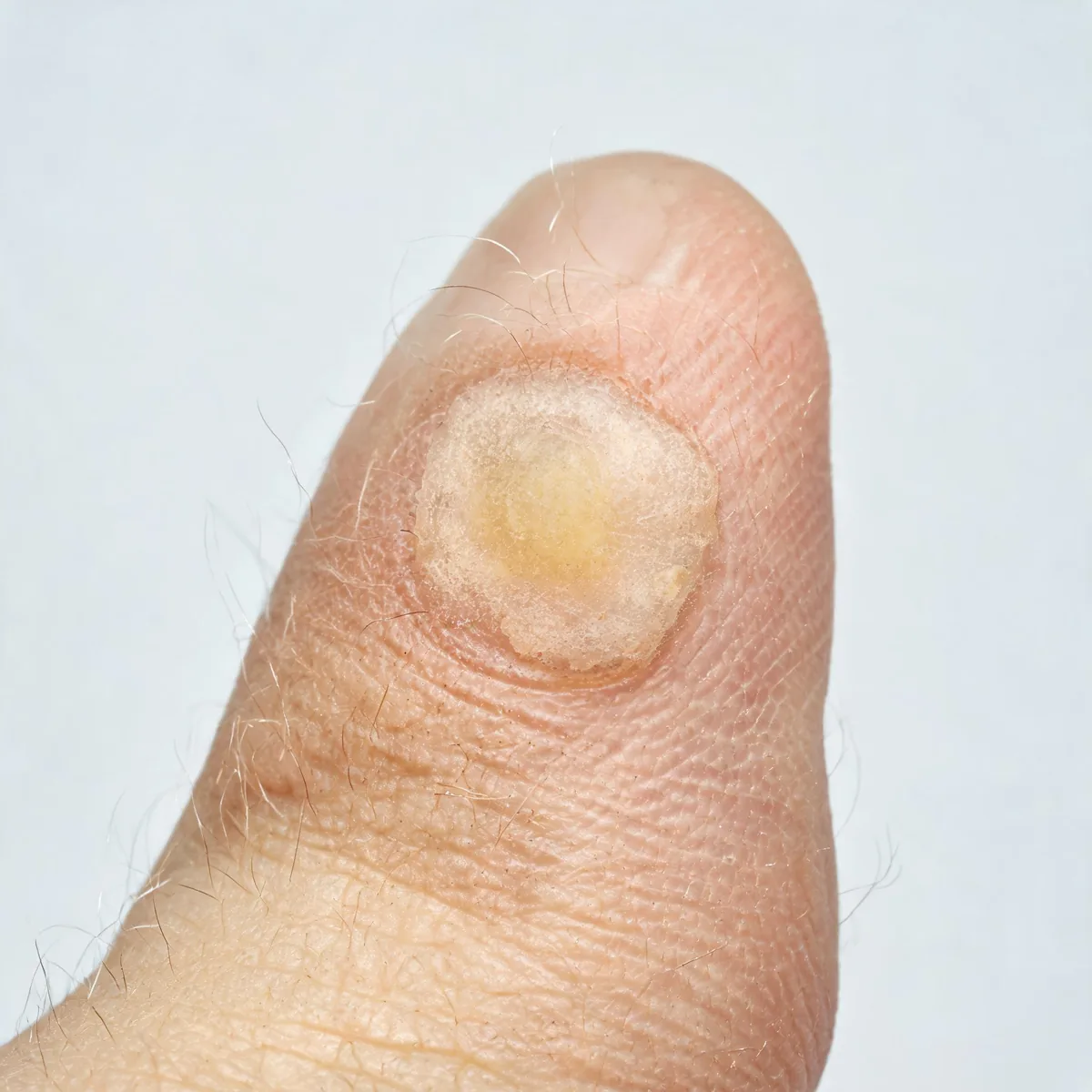
Which type is yours?
A corn is read as something stuck: Qi, Blood or moisture trapped in the foot where friction presses. Removing the pressure removes the cause, which is why footwear matters as much as herbs.
Qi And Blood Stagnation
Hard painful corn with a dark or purplish hue.
Looks like: Fixed stabbing pain in the corn; Pain worse with direct pressure
Read about this typeDamp-Heat
Red swollen corn with burning pain and moistness.
Looks like: Redness and swelling around the corn; Pain that feels hot or burning
Read about this typeSpleen Deficiency with Dampness
Soft pale moist corns with sweaty damp feet.
Looks like: Not specified
Read about this typeDamp-Phlegm
Large hard corn with a waxy feel and body heaviness.
Looks like: Not specified
Read about this typeLiver Qi Stagnation
Corn pain that worsens with emotional stress.
Looks like: Corn pain worsens with emotional stress
Read about this typeNot sure which? Take the Pattern check
Compare the typesWhere the spots sit, what they look like, the tongue and the main formula
Five patterns are described for corns, and three questions separate them. How hard is the lesion? A dense, painful, dark corn that stabs when pressed belongs to Qi and Blood Stagnation, where friction has trapped Blood in one small area. A soft, pale, slightly moist corn on a sweaty foot belongs to Spleen Deficiency with Dampness, where moisture is not being processed. A large, waxy corn that resists paring belongs to Damp-Phlegm, where chronic Dampness has thickened. What does the skin around it look like? Redness, swelling and a burning sensation point to Damp-Heat. And when does it hurt? A corn whose pain rises with emotional stress, in a person who sighs and feels rib-side distension, points to Liver Qi Stagnation, since the Liver channel reaches the foot and governs the smooth flow of Qi. Patterns overlap in practice, but the dominant one decides the formula.
| Pattern | Key signs | Tongue |
|---|---|---|
| Qi And Blood Stagnation | Fixed stabbing pain in the corn; Pain worse with direct pressure | Body: Purple or dark, with stasis spots; sublingual veins dark and distendedCoat: Thin white |
| Damp-Heat | Redness and swelling around the corn; Pain that feels hot or burning | Body: Red, often swollen with teeth marksCoat: Yellow, greasy and thick, usually in the middle and at the root |
| Spleen Deficiency with Dampness | Not specified | Body: Pale and swollen, often with teeth marks along the edgesCoat: White, greasy and moist, thick in the middle |
| Damp-Phlegm | Not specified | Body: Pale, swollen and teeth-marked, wet-lookingCoat: Thick, white and greasy |
| Liver Qi Stagnation | Corn pain worsens with emotional stress | Body: Normal or slightly dark, with red or purple sidesCoat: Thin white |
Qi And Blood StagnationHard painful corn with a dark or purplish hue.
Avoid in pregnancy Caution in pregnancy
Hard painful corn with a dark or purplish hue.
Repeated pressure at one small point of the foot blocks the local movement of Qi and Blood. The tissue underneath is starved of nourishment and cannot clear its own waste, so it thickens into a hard lump; the trapped Blood gives it a dark or purplish colour, and pressure produces a sharp fixed stab rather than a dull ache. The corn is a knot of congealed Blood as much as a pad of keratin, which is why paring it away rarely settles the pain for long.
The tongue is purple or dark with stasis spots and the sublingual veins are distended, and the pulse is wiry and choppy. Tight, ill-fitting or damp shoes, long hours on the feet, cold exposure and emotional stress aggravate it, while warm soaks, gentle massage, soft roomy shoes and rest with the feet raised relieve it. Xue Fu Zhu Yu Tang moves Blood and stops pain through Tao Ren, Hong Hua and Ru Xiang, and the points are LR-3 Taichong, SP-10 Xuehai and LI-4 Hegu.
Signs
- Fixed stabbing pain in the corn
- Hard corn with a dark or purplish hue
- Pain worse with direct pressure
- Dark purple tongue with stasis spots
Diet and lifestyle for this pattern: Switch to soft, wide shoes that do not pinch or rub. A daily warm foot soak with Epsom salts or fresh ginger softens the corn and promotes local circulation, followed by a gentle massage with warm sesame oil. Avoid cold raw food and iced drinks that congeal Blood, and use mild warming spices such as turmeric and ginger in cooking.
Damp-HeatRed swollen corn with burning pain and moistness.
Avoid in pregnancy Caution in pregnancy
Red swollen corn with burning pain and moistness.
Here Dampness and Heat lodge in the skin of the foot at the same time, usually where an internal tendency meets the warmth and moisture of a closed shoe. Dampness softens and macerates the skin, Heat reddens and inflames it, and the combination produces a corn that is tender, burning and sometimes sticky or slightly weeping rather than dry and hard. It is the one pattern in which the lesion looks angry rather than merely thick, and the surrounding skin is as much the target as the corn itself.
The tongue body is red under a yellow greasy coat, and the pulse is slippery and rapid. Hot humid weather, footwear that stays wet, hot and greasy dishes, alcohol and long hours on the feet worsen it, while a cool dry environment, cool water soaks, open sandals and light meals ease it. Huang Lian Jie Du Tang supplies the cooling and drying action through Huang Lian, Huang Bo and Ku Shen, and the points are SP-6 Sanyinjiao, SP-9 Yinlingquan, LI-11 Quchi and LR-3 Taichong.
Signs
- Redness and swelling around the corn
- Pain that feels hot or burning
- Sticky or moist sensation at the site
- Heaviness with a greasy taste
Diet and lifestyle for this pattern: Avoid greasy, spicy and sugary food that generates Dampness and Heat. Keep the feet clean and dry, change socks daily, choose breathable footwear, and a cool salt water soak can help reduce inflammation.
Spleen Deficiency with DampnessSoft pale moist corns with sweaty damp feet.
Avoid in pregnancy Caution in pregnancy
Soft pale moist corns with sweaty damp feet.
A Spleen that cannot transform fluids leaves moisture circulating where it should not be, and gravity carries it down into the feet. Trapped under the skin by shoe pressure, that moisture thickens the tissue into soft, pale corns, and the foot itself tends to sweat and stay damp. Because the root is a deficiency rather than a blockage, the corn is less painful than the stasis type but far more persistent, and it returns whenever digestion is under strain.
The tongue is pale and swollen with teeth marks under a white greasy coat on a moist surface, and the pulse is soggy and slow, or slippery. Humid weather, overwork, cold raw or greasy food and damp shoes make it worse, while warm dry weather, rest with the feet raised, light warm meals and warm foot soaks help. Shen Ling Bai Zhu San tonifies the Spleen and drains Dampness through Fu Ling, Yi Yi Ren and Bai Zhu, and the points are ST-36 Zusanli, SP-6 Sanyinjiao and SP-9 Yinlingquan.
Signs
- Soft pale corns that may feel moist
- Feet sweat easily and feel damp
- Fatigue and heavy limbs
- Poor appetite with bloating and loose stools
Diet and lifestyle for this pattern: Eat warm cooked food such as soups and stews, and avoid cold, raw, greasy and sweet food that creates Dampness. Soak the feet daily in warm salted water to soften corns and disperse local moisture, wear breathable shoes and change socks often.
Damp-PhlegmLarge hard corn with a waxy feel and body heaviness.
Avoid in pregnancy Caution in pregnancy
Large hard corn with a waxy feel and body heaviness.
When Dampness is left unprocessed for long enough it condenses into Phlegm, a thicker and more turbid substance that binds the tissue rather than merely moistening it. Sinking to the feet, it clogs the local channels so that the skin cannot shed normally, and the result is a large, hard, waxy corn that resists paring and feels heavy rather than sharp. The body often feels heavy with it, and there may be fullness in the chest or epigastrium, drowsiness and a foggy head.
The tongue is pale and swollen with scalloped edges under a thick, white, oily-looking greasy coat, and the pulse is slippery, like beads rolling in oil, sometimes soggy as well. Tight or damp shoes, cold and raw food, a sedentary routine, humid weather and greasy or spicy food aggravate it, while warm dry socks, ginger or mugwort soaks, gentle walking and light meals relieve it. Er Chen Tang dries Dampness and transforms Phlegm with Ban Xia, Chen Pi and Fu Ling, and the points are ST-40 Fenglong, ST-36 Zusanli, SP-9 Yinlingquan and BL-20 Pishu.
Signs
- Large hard corn with a sticky or waxy feel
- Heaviness in body and limbs
- Chest or epigastric fullness
- Fatigue and drowsiness
Diet and lifestyle for this pattern: Avoid cold, raw, greasy and sweet food that creates Dampness. Favour warm cooked meals such as congee with Job's tears and a little ginger, keep the feet dry in breathable shoes, and walk daily so Qi keeps moving.
Liver Qi StagnationCorn pain that worsens with emotional stress.
Avoid in pregnancy Caution in pregnancy
Corn pain that worsens with emotional stress.
The Liver keeps Qi and Blood moving evenly through the body, and when stress, frustration or held anger constrains it that movement becomes hesitant. The feet, already working under pressure, then get less Blood to nourish them and more Qi that has stopped moving, and the skin hardens more readily at the point of friction. The corn in this pattern is often tender rather than rock-hard, and its pain tracks the person's mood rather than the tightness of the shoe.
The tongue body is normal or slightly dark with red or slightly purple sides under a thin white coat, and the pulse is wiry, taut like a guitar string. Emotional stress, frustration or anger, tight or damp shoes and long hours on the feet make it worse, while relaxation, gentle stretching or yoga and warm foot soaks relieve it. Chai Hu Shu Gan San smooths Liver Qi through Chai Hu and Xiang Fu, and the points are LR-3 Taichong, SP-6 Sanyinjiao and LR-14 Qimen.
Signs
- Irritability or short temper
- Frequent sighing
- Rib-side distension or discomfort
- Corn pain worsens with emotional stress
Diet and lifestyle for this pattern: Regular gentle movement such as walking or stretching keeps Liver Qi flowing, and long sitting plus tight restrictive footwear work against it. Add aromatic herbs such as mint and basil to meals, and limit alcohol and greasy food that burden the Liver.
What you can do
Start with the daily measures that match your type. Herbs and formulas come after these, and only with a practitioner.
- Qi And Blood Stagnation: Switch to soft, wide shoes that do not pinch or rub. A daily warm foot soak with Epsom salts or fresh ginger softens the corn and promotes local circulation, followed by a gentle massage with warm sesame oil. Avoid cold raw food and iced drinks that congeal Blood, and use mild warming spices such as turmeric and ginger in cooking.
- Damp-Heat: Avoid greasy, spicy and sugary food that generates Dampness and Heat. Keep the feet clean and dry, change socks daily, choose breathable footwear, and a cool salt water soak can help reduce inflammation.
- Spleen Deficiency with Dampness: Eat warm cooked food such as soups and stews, and avoid cold, raw, greasy and sweet food that creates Dampness. Soak the feet daily in warm salted water to soften corns and disperse local moisture, wear breathable shoes and change socks often.
- Damp-Phlegm: Avoid cold, raw, greasy and sweet food that creates Dampness. Favour warm cooked meals such as congee with Job's tears and a little ginger, keep the feet dry in breathable shoes, and walk daily so Qi keeps moving.
- Liver Qi Stagnation: Regular gentle movement such as walking or stretching keeps Liver Qi flowing, and long sitting plus tight restrictive footwear work against it. Add aromatic herbs such as mint and basil to meals, and limit alcohol and greasy food that burden the Liver.
Everyday habitsDiet and routine advice for every type
- Reduce dampness-forming food such as sugar, dairy and greasy food, and favour warm cooked meals.
- The general rule is to eat in a way that leaves no residue for the body to store: warm cooked meals, soups, congees, steamed vegetables and moderate lean protein, with a little ginger, scallion and black pepper to help the Spleen handle moisture, and less deep-fried food, dairy, sugar, alcohol and raw cold food. Pattern detail then refines it: turmeric with ginger and a little black pepper for Blood stasis; cucumber, mung beans and barley with no alcohol for Damp-Heat; warm soups and stews with nothing cold or greasy for Spleen deficiency; congee with Job's tears and ginger for Damp-Phlegm; and mint, basil and leafy greens with less alcohol for Liver Qi stagnation.
Beauty practices:
What a practitioner might use
Herbs are prescribed to the pattern by a qualified practitioner. Do not self-prescribe.
Avoid in pregnancy Caution in pregnancy
Acupoints 10
Formulas 5
Herbs 13
- Tao Ren 桃仁Avoid in pregnancy
- Hong Hua 红花Avoid in pregnancy
- Ru Xiang 乳香Avoid in pregnancy
- Huang Lian 黄连Caution in pregnancy
- Huang Bo 黄柏Caution in pregnancy
- Ku Shen 苦参Caution in pregnancy
- Fu Ling 茯苓
- Yi Yi Ren 薏苡仁Caution in pregnancy
- Bai Zhu 白术
- Ban Xia 半夏Avoid in pregnancy
- Chen Pi 陈皮Caution in pregnancy
- Chai Hu 柴胡Caution in pregnancy
- Xiang Fu 香附Avoid in pregnancy
What each one is used for is in the notes below.
Herbs, formulas and acupointsPrinciples, the herbs and points used, and what to expect
Avoid in pregnancy Caution in pregnancy
How the tradition treats corns, with the herbs, formulas and points used for it.
Principles
- Remove the pressure source: footwear, padding and gait are the practical treatment.
- Move Qi and Blood where the corn is hard and painful.
- Drain dampness where the foot is sweaty and the corn soft.
- Do not cut corns at home, especially with diabetes or poor circulation.
- The strategy is always two-layered: treat the branch at the surface and the root in the organs. Externally, soaks, plasters and local needling soften the keratin and move what is stuck; internally, the formula follows the pattern, with Xue Fu Zhu Yu Tang for stasis, Huang Lian Jie Du Tang for Damp-Heat, Shen Ling Bai Zhu San for Spleen deficiency, Er Chen Tang for Phlegm and Chai Hu Shu Gan San for Liver constraint, and the points matched to the same logic.
Herbs used
Formulas
Acupoints
- LR-3 (Taichong)
- SP-10 (Xuehai)
- LI-4 (Hegu)Avoid in pregnancy
- SP-6 (Sanyinjiao)Avoid in pregnancy
- SP-9 (Yinlingquan)
- LI-11 (Quchi)
- ST-36 (Zusanli)
- ST-40 (Fenglong)
- BL-20 (Pishu)
- LR-14 (Qimen)
What to expect
- Corns resolve once pressure is removed, over several weeks.
- Recurrence is expected if footwear does not change.
- Infected or ulcerated lesions need medical care, and diabetic foot lesions need urgent review.
- A soft corn tends to soften inside one to two weeks of soaks and dietary change, while a hard corn from Blood stasis may need three to four weeks before the pain clearly eases and six to eight weeks for full resolution. Internal patterns such as Spleen deficiency or Liver stagnation take one to three months of consistent herbal treatment, and a corn that has been pared or acid-treated repeatedly will take longer, so judge progress by pain on walking and by how quickly the skin re-thickens rather than by size alone.
Formulas often used
Safety and when to see a doctor
Seek medical help urgently for
- Signs of infection: redness, warmth, swelling, pus or red streaks.
- An ulcer or open wound on the foot.
- Any foot lesion in someone with diabetes or poor circulation.
Avoid in pregnancy
Some herbs and points named on this page carry pregnancy warnings. They are marked where they appear, and each links to its own safety notes.
Cautions
- Do not cut, shave or use strong acid plasters on corns without advice.
- Diabetic foot lesions need professional care.
- Persistent pain needs assessment for other causes.
Using this alongside conventional care
- TCM is described as complementary to conventional care: podiatry and footwear management are the core, with herbs for the constitutional pattern.
- Padding, orthotics and well-fitted shoes can continue alongside herbal treatment, and there is no need to choose between them. The cautions that matter are local and systemic: do not put a salicylic acid patch and a herbal plaster on the same spot at the same time, because the combined effect can macerate healthy skin, and space them by several hours or alternate days; and tell both your doctor and your practitioner if you take warfarin or aspirin, since formulas built on Tao Ren, Hong Hua or Ru Xiang add to the effect of blood thinners. Anyone with diabetes or reduced sensation should have the foot examined before any home treatment begins.
If you're pregnant
Extra weight and foot swelling in pregnancy can worsen corns, but internal treatment must be cautious. Formulas containing strong blood-moving herbs such as Tao Ren and Hong Hua and Ru Xiang are avoided in pregnancy instead.
Acupuncture at Hegu (LI-4) and Sanyinjiao (SP-6) should be avoided because these points can induce labour, and the Spleen deficiency with Dampness pattern common in pregnancy can be treated with Shen Ling Bai Zhu San, generally safe, to reduce Dampness. An experienced practitioner should be consulted before any treatment.
If you're breastfeeding
Topical herbal soaks and external applications are generally safe while breastfeeding provided the skin is intact and the herbs are not ingested. If internal formulas are needed for severe or recurrent corns, avoid bitter-cold herbs such as Huang Lian and Huang Bo, which can pass into milk and cause infant diarrhoea, and for Damp-Heat patterns milder external washes with Ku Shen are preferred.
Acupuncture on the feet is safe and can relieve pain and improve local circulation without affecting milk supply.
If treating a child
Corns are less common in children but can follow ill-fitting shoes or high activity, and the Spleen deficiency with Dampness pattern is often present, especially with sweaty feet and digestive issues.
Treatment prioritises external soaks with gentle herbs such as Yi Yi Ren and Fu Ling and avoids strong blood-moving herbs internally, with formulas such as Shen Ling Bai Zhu San reduced to a third to a half of the adult dose by age and weight. Acupuncture is usually replaced by acupressure or gentle massage at points such as Zusanli (ST-36) and Sanyinjiao (SP-6) to avoid needle fear.
If treating an elderly patient
In older people corns are often complicated by poor circulation, diabetic neuropathy or fragile skin, and the common patterns are Qi and Blood deficiency leading to stagnation, and Spleen-Kidney Yang deficiency with Dampness accumulation.
Treatment must be gentle: external soaks with warm nourishing herbs such as Shu Di Huang and Dang Gui soften the corn without damaging fragile skin, internal formulas use about two-thirds of the adult dose and avoid strong diuretics, and acupuncture at points such as Taichong (LR-3) and Zusanli (ST-36) can improve local flow with shallow careful needling. Regular foot care and well-fitted shoes matter even more in this age group.
Urgent-sign guidance is based on standard sources: NHS anaphylaxis, NHS cellulitis, NHS Stevens-Johnson syndrome, NHS melanoma.
Avoid in pregnancy
For anything severe, sudden or spreading quickly, read when a skin problem needs urgent care.
Understanding
The tradition describes a corn as a sign that Qi, Blood or moisture has become trapped in the foot, with internal imbalance making the skin more vulnerable to everyday friction.
Qi and Blood stagnation gives fixed stabbing pain in a hard corn with a dark or purplish hue, pain worse with direct pressure and a dark purple tongue with stasis spots. That is the pattern behind a painful, hardened lesion.
Read more about how Corns is understood
Damp-Heat gives redness and swelling around the corn with burning pain, a sticky or moist sensation at the site, heaviness and a greasy taste. Spleen deficiency with dampness gives soft pale corns that feel moist, sweaty damp feet, fatigue, bloating and loose stools.
Damp-Phlegm gives a large hard corn with a sticky or waxy feel, body heaviness, chest or epigastric fullness and drowsiness. Liver Qi stagnation gives corn pain that worsens with emotional stress, with irritability, sighing and rib-side distension.
The foot is the lowest point of the body, and in Chinese medicine that position is not neutral. Heavy, turbid and sticky substances such as Dampness, Phlegm and pooled Blood tend to gather at the bottom of the system, much as sediment settles in still water. Shoes supply the second ingredient: pressure and shear over a small area of skin, repeated for hours every day. Neither the internal stagnation nor the shoe alone makes a corn; the two together do, which is why a person can wear the same tight pair for years and only develop a corn during a spell of poor digestion or stress.
Which substance is stuck decides the picture. A weak Spleen leaves moisture unprocessed, and the result is a soft, pale, slightly damp corn on a foot that sweats easily. A constrained Liver slows the movement of Qi and Blood, and the result is a hard, dark corn with a sharp stabbing pain. Dampness meeting Heat, from rich food or from sweaty footwear, produces redness, swelling and a burning tenderness. When chronic Dampness thickens further it becomes Phlegm, and the corn turns large, waxy and stubborn. Under a sock the lesions look similar, but the treatments are not interchangeable.
Because of that, the examination is never only of the foot. The practitioner wants to know how digestion behaves, whether the feet sweat, how sleep and mood are, and what the tongue and pulse show, since these separate one root from another. A formula that drains Dampness will do nothing for a corn maintained by Liver Qi stagnation, and a Blood-moving formula given for a Damp-Heat corn can make the surrounding skin angrier. The aim is to dissolve the lesion by clearing what is stuck and by correcting whichever system allowed it to gather.
The conventional viewHow conventional medicine describes and treats Corns
A corn is a small thickened area of skin on the toes or soles formed in response to repeated pressure or friction, as the skin protects itself with a hard cone-shaped core that can press into deeper tissue and cause sharp pain. Corns are usually diagnosed by appearance and location, hard corns on the tops of toes and soft corns between them, and are often confused with calluses or warts.
Standard treatment includes over-the-counter salicylic acid pads or liquids to dissolve keratin, professional trimming by a podiatrist, and cushioned pads or orthotics to redistribute pressure, with surgery to correct an underlying bone abnormality in persistent cases. Most of these give temporary relief, and the corn returns if the source of friction is not removed.
Salicylic patches, padding and trimming treat the corn itself but not why the skin thickened, so corns recur because the underlying susceptibility, whether internal Dampness, Blood stasis or organ weakness, remains. Chemical treatment can irritate surrounding healthy skin and repeated trimming carries a small infection risk.
Selected PubMed records
Real PubMed records for the conventional discussion above, selected by condition name and title relevance. They are references, not a claim that any treatment is proven for this condition.
- Corns and calluses resulting from mechanical hyperkeratosis.. American family physician, 2002. PMID: 12074526.
How it is assessed
The practitioner examines the corn and the foot, and asks about footwear and pressure.
What a practitioner looks for
What a practitioner looks for
- Texture: hard corns suggest stagnation; soft pale moist corns suggest Spleen deficiency with dampness.
- Surrounding skin: redness and warmth around a corn suggests Damp-Heat or infection.
- Pressure points: lesion location identifies the footwear or gait problem.
- Red flags: diabetes, reduced sensation, ulceration or infection.
Diagnosis starts with the corn itself. Its site, width, hardness and colour are recorded, together with the state of the skin around it and the shape of the shoes normally worn. Texture carries a good deal of information: a rock-hard, sharply painful corn with a dusky tinge reads as stagnation, a soft, pale, moist one reads as Spleen deficiency, and a large waxy one that resists paring reads as Phlegm.
The questions then widen. A practitioner asks how long the corn has been present, whether it has been cut or treated with acids, whether the feet sweat or stay dry, how digestion behaves, and whether the pain changes with rest, with weather or with stress. A corn that eases when the feet are raised and the shoes come off points to local stagnation from pressure; one that flares during a stressful week, with a wiry pulse and a red tongue edge, points to Liver Qi stagnation; one that burns and weeps in humid weather, with a yellow greasy coat and a slippery rapid pulse, points to Damp-Heat.
Red flags are checked before treatment begins. Diabetes, reduced sensation in the feet, poor circulation, spreading redness, pus, fever or a blackened area all change the plan, because a corn that is cut or treated with acid at home can become an ulcer. The tongue and pulse complete the picture, and the practitioner will usually confirm which pattern dominates before choosing a formula, since much of the treatment is internal and has to be right.
Evidence
Evidence status
Compiled for this page from the classical and modern literature; not a systematic review, so treat it as a pointer to sources rather than clinical guidance.
Clinical evidence is limited but suggestive. Small Chinese randomised trials report that herbal soaks and external plasters soften and remove corns with lower recurrence than salicylic acid, and case series describe acupuncture at local Ashi points with distal points such as Taichong (LR-3) relieving pain and helping resolution. Most studies are small, unblinded and published only in Chinese, so the evidence is not robust by Western standards.
The published base is small and almost entirely Chinese. One randomised trial gave patients an external soak of Tao Ren, Hong Hua and Ru Xiang and reported complete resolution in 78 per cent against 62 per cent for salicylic acid plaster, with fewer recurrences at six months; a case series of needling at Ashi points reported an 85 per cent cure rate after three sessions; and a study of a paste made from Xue Fu Zhu Yu Tang reported less pain and a smaller lesion at two weeks. Case series and small trials point the same way, but none is blinded, the samples are small, and standardised outcome measures are missing.
Studies often cited
Context only; related research, not evidence of effect for this page.
Classical record
Corns grow on the toes, shaped like a chicken eye, hard and painful. They are caused by Damp-Heat pouring downward and Qi-Blood congealing. Treatment should clear Heat and drain Dampness, invigorate Blood and soften hardness.
- - Wai Ke Zheng Zong (Orthodox Manual of External Medicine), chapter on corns. The Chinese original is not reproduced here: it could not be recovered reliably from the source record, and is not guessed.
肉刺者,由著靴急窄,皮肉相搏,气血涩滞,故令皮肉生刺也。
肉刺者,由著靴急窄,皮肉相搏,气血涩滞,故令皮肉生刺也。 Flesh thorns come from boots that are too tight and narrow, so that skin and flesh rub against each other and the Qi and Blood become rough and stagnant, and thorns grow in the skin.
Zhubing Yuanhou Lun on flesh thorns - Zhubing Yuanhou Lun (Treatise on the Origins and Symptoms of Diseases), chapter on flesh thorns, translated from the Chinese original as recorded in the classical literature.
Common questions
Can herbs cure a corn?
No. A corn is pressure-driven, so removing the pressure is essential. Herbs may support the constitutional pattern.
Should I cut it off?
No, especially with diabetes or poor circulation. See a professional.
Why do corns keep coming back?
Because the footwear or gait pressure has not changed.
When is a corn urgent?
With infection signs, an ulcer, or any foot lesion in diabetes.
How does acupuncture help corns?
Needling eases the pain and restores circulation to the tissue beneath the corn. Points on the leg such as ST-36 Zusanli and SP-6 Sanyinjiao tonify the Spleen and clear Dampness, while points around the lesion break up the local stagnation, and moxa is used where the corn is hard and cold. Many people feel the pain settle within the first few sessions, and the skin softens over a course of treatment.
Are herbal plasters safe to use at home?
They are safe when the right one is chosen and used as directed. A cooling, drying plaster suits a red, burning corn but will not help a hard, dark one from Blood stasis, and may irritate the skin around it. Never apply a plaster to broken skin, never leave one on longer than instructed, and stop at once if the surrounding skin becomes sore, itchy or weepy. A practitioner can match the plaster to the pattern.
How many acupuncture sessions will I need?
Treatment is usually once or twice a week. Pain often eases after the first few sessions, and a course of four to six weeks is common before the corn softens substantially. Deeper internal patterns such as Spleen deficiency or Liver Qi stagnation need longer, and the practitioner will reassess the lesion, the tongue and the pulse every few weeks rather than fixing a set number in advance.
Is TCM safe for corns if I have diabetes?
When someone has diabetes or circulation that is poor, a corn needs medical assessment before anything else, and it should never be cut or treated with over-the-counter acids at home. Gentle herbal soaks and acupuncture can help under supervision, but the foot must be examined by a doctor, the footwear checked for pressure points, and any break in the skin or change in colour reported promptly.