Acupoint · Acupressure only
Xiaguan
下关
Location
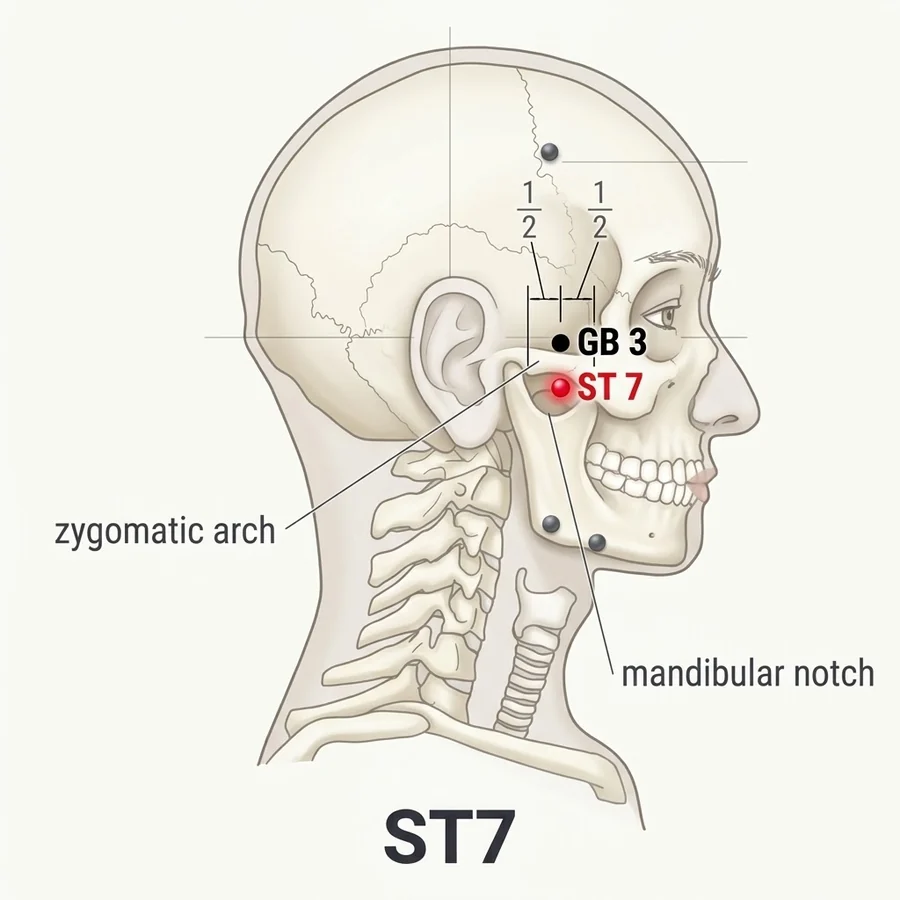
Standard location. On the face, in the depression between the midpoint of the inferior border of the zygomatic arch and the mandibular notch.
How to find it. Find the lower edge of the cheekbone in front of the ear, then feel just below it with the mouth closed. The hollow there, over the jaw joint, is the point.
It sits over the temporomandibular joint. If the jaw clicks or hurts when pressed, stop.
Acupressure
What it is used for
Skin and face
- Jaw and cheek tension, especially after clenching
- The jaw step of the sequence on facial-acupressure
- Where the pattern is read as Qi And Blood Stagnation in the lower face
- Alongside Jiache (ST-6) at the angle of the jaw
Actions
- Clears the channel through the cheek and jaw
- Relieves facial pain and toothache
- Relaxes the jaw joint and the masseter
- Used for ear conditions in the tradition
Practitioner note
Safety
Safety and when to get help
- Over the temporomandibular joint: light pressure only.
- Not pressed during an acute jaw lock or a painful jaw-joint episode, which needs assessment rather than acupressure.
- Do not press over a swollen or infected area in front of the ear.
- Needling this point is a practitioner procedure and is not described on this page.
Used with
Common questions
Where is Xiaguan?
In the hollow below the lower edge of the cheekbone, just in front of the ear, over the jaw joint.
Why is it not pressed with a locked jaw?
Because the point sits on the joint. A locked or painful jaw needs assessment, and pressure over it can make it worse.
Does it help clenching?
It is traditionally used for jaw and cheek tension, and the routine described on the facial acupressure page is where it belongs.
How it is understood
Xiaguan sits over the temporomandibular joint, in the hollow between the cheekbone and the jaw. The tradition uses it for facial pain, toothache, ear conditions and jaw stiffness, and in a facial routine it is the point for jaw and cheek tension. Because it lies over the joint, it is not pressed during an acute jaw lock or a painful joint episode: that needs assessment, not acupressure.
Sources
Guidelines and standards
ST-7 Xiaguan
On the face, in the depression between the midpoint of the inferior border of the zygomatic arch and the mandibular notch.
WHO Standard Acupuncture Point Locations in the Western Pacific Region World Health Organization, Regional Office for the Western Pacific, 2008.
Location quoted from the WHO standard. The classical record for this point has not been verified against a primary text here, so it is not quoted.